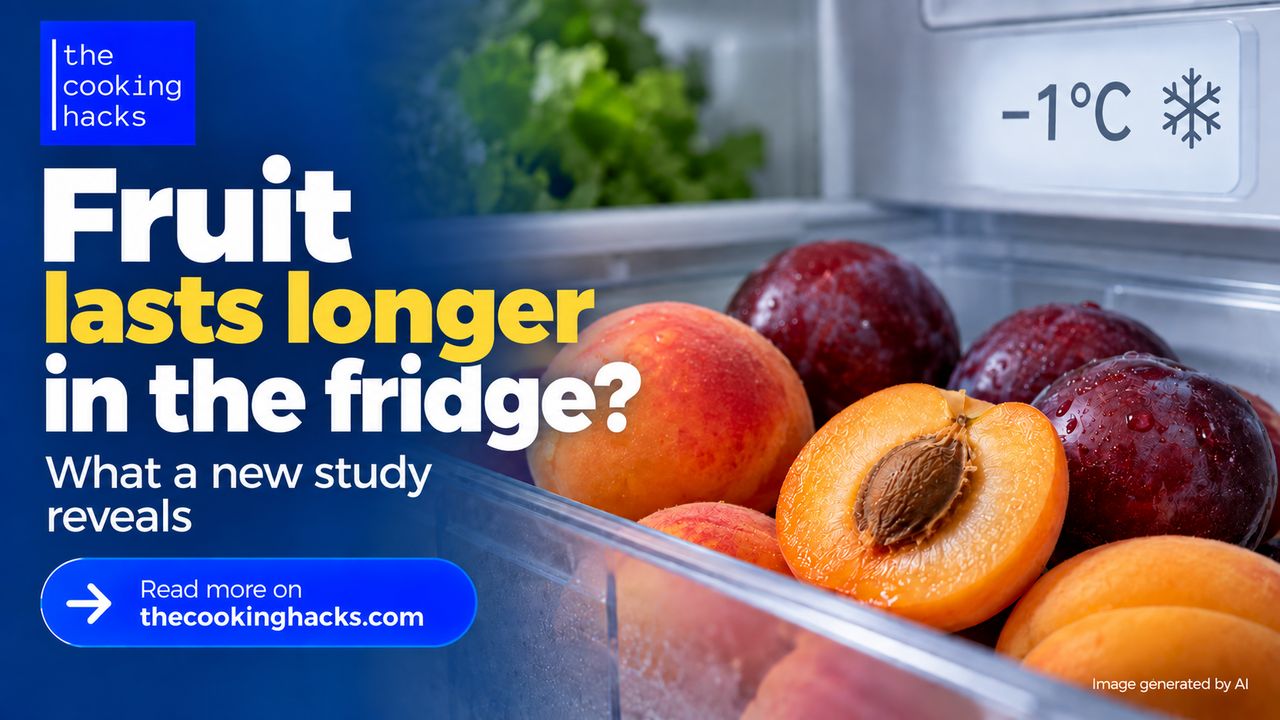
Keeping a fruit very close to its freezing point may slow deterioration and preserve some quality characteristics, but it does not mean a home refrigerator should be set below 0°C (32°F). A study published on September 9, 2026 in Food Quality and Safety tested an apricot–plum hybrid, Prunus domestica × armeniaca. Researchers measured its freezing point at about −3.1°C (26°F) and selected −1°C (30°F) for near-freezing storage. Compared with room temperature and conventional cold storage, fruit kept under the near-freezing condition retained firmness, soluble solids, titratable acidity and its aroma-related volatile profile more effectively, while losing less weight.
What does near-freezing storage actually mean?
Near-freezing storage does not simply mean keeping food close to 0°C. The approach is based on holding a product above its own freezing point while remaining close to that threshold.
For the apricot–plum hybrid in this study, researchers measured a freezing point of approximately −3.1°C (26°F) and chose −1°C (30°F) as the near-freezing treatment. They compared it with room-temperature and conventional low-temperature storage.
That distinction matters because −1°C is not a universal optimum for fresh fruit. Different fruits can respond differently to low temperatures, and excessive chilling may itself damage some produce.
What did the −1°C storage preserve?
The main findings concern postharvest quality, rather than health or nutrition. Near-freezing storage maintained greater firmness and marketability, reduced weight loss and better preserved soluble solids and titratable acidity than the comparison conditions.
Changes in aroma-related volatile compounds were also more limited. Further analysis found better preservation of cell-wall and membrane integrity compared with room-temperature storage, together with slower starch depletion and sucrose loss.
Those results should not be turned into a claim that fruit stored at −1°C is nutritionally superior. The study investigated how storage temperature affected the quality and physiology of this particular fruit.
Should you set your refrigerator to −1°C? No
The experimental temperature is not a new household food-storage recommendation. In the UK, the Food Standards Agency advises keeping your refrigerator between 0°C and 5°C (32°F and 41°F). In the United States, FDA guidance says refrigerators should be kept at 40°F (4°C) or below.
The researchers were working with one fruit hybrid under controlled postharvest conditions and had first measured its freezing point. A household refrigerator contains foods with very different properties and storage requirements.
Simply lowering a domestic refrigerator below freezing would therefore not reproduce the experiment and could freeze or damage other foods.
How does this relate to the −15°C frozen-food study?
We recently looked at research on frozen food stored at −15°C (5°F) instead of −18°C (0°F). The two studies address very different questions, but they make one useful point together: a difference of only a few degrees can matter in food storage, and the effect depends on what is being stored and why.
The frozen-food study started with products that were already frozen and examined what happened when their storage temperature was raised. The new fruit study does the opposite: it attempts to keep fresh fruit as cold as possible without actually freezing it.
The temperatures are therefore not interchangeable, and neither study provides a reason to change a home appliance setting outside current food-safety guidance.
What can we actually conclude?
For the apricot–plum hybrid tested, storage close to its measured freezing point preserved commercial quality and aroma-related characteristics more effectively under the conditions studied. The findings support near-freezing storage as a postharvest management technique for this fruit, not −1°C as a general rule for fresh produce.
The paper is currently available as an accepted manuscript. This means it has been accepted for publication but has not yet gone through final copyediting and typesetting. Oxford University Press notes that the final published version may contain changes, while the DOI will remain the same.
If you don't want to miss the important news, subscribe to The Cooking Hacks Telegram channels:
- Food Recall UK, receive news about food recalls to have a safe pantry
- Offers this week UK, to find out what are the latest offers from supermarkets