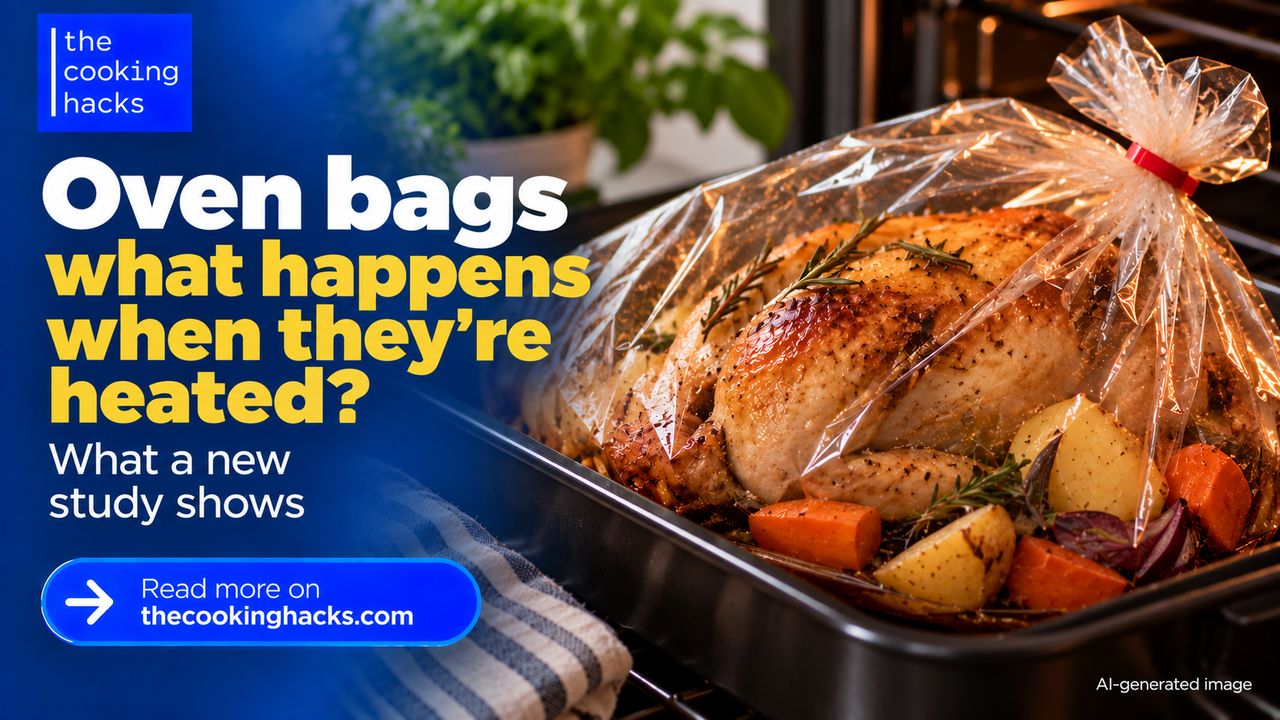
Oven bags are made to do something that would be a bad idea with an ordinary plastic bag: sit around food while it cooks at high temperatures. That makes an obvious question worth asking. What happens to the plastic as the oven gets hotter?
A new study published in Chemosphere tested commercial oven bags made from two different plastics: polyamide, commonly called nylon, and PET, short for polyethylene terephthalate. The researchers found that the polyamide bags released more material as temperatures increased. The PET bags released substantially less under the conditions tested.
One point needs to be clear from the start: the study did not show that using an oven bag harms people.
The toxicity test was carried out on Daphnia magna, a tiny freshwater crustacean widely used in laboratory testing. An effect in Daphnia is scientifically relevant, but it is not the same as demonstrating a health effect in someone eating food cooked in an oven bag.
What did the researchers actually test?
The simplest way to understand the experiment is to think about material moving out of the plastic when it is exposed to heat.
The researchers tested commercially available polyamide and PET oven bags bought in Sweden and examined material released under different experimental conditions.
At room temperature, the material released from the bags did not cause significant effects in the Daphnia test. At higher temperatures, material released from the polyamide bags caused significant immobilisation of the organisms.
In everyday language, the small aquatic animals became unable to move normally after exposure to the mixture released by the heated polyamide bags.
That tells researchers that the mixture had a biological effect under those test conditions. It does not tell us what would happen to a person eating food prepared in one of those bags.
Were microplastics responsible?
Not primarily, according to the experiment. The researchers separated the released material into different size groups. The biological effect was associated mainly with small molecular components, rather than the larger particles.
That distinction matters because it would be easy to turn the study into a story simply about microplastics. The results do not support such a simple conclusion.
The more useful question raised by the research is broader: what substances can move out of a food-contact plastic when it is heated, and how does temperature affect that release?
Nylon and PET oven bags behaved differently
Another important finding is that the two types of plastic did not behave in the same way. The PET oven bags released substantially less material and produced no detectable toxicity in the Daphnia test under the conditions used in the study.
That does not prove that every PET oven bag is safe under every possible condition. Nor does the result for polyamide prove that every nylon oven bag is unsafe.
The study examined particular products under controlled experimental conditions. It can identify a reason for further research, but it cannot be used to give every oven bag on supermarket shelves the same verdict.
Does the study show that oven bags are dangerous to people?
No. That is not what was tested. Finding a biological effect in Daphnia magna is not equivalent to finding a health effect in humans.
To assess a potential risk to people, researchers would need to answer additional questions. Which substances actually move into food? How much reaches the food under realistic cooking conditions? How much of those substances would a person consume? And what does toxicological evidence tell us about those levels of exposure?
The new study does not answer all of those questions.
This distinction between a hazard signal in an experimental test and an actual risk to consumers is essential. The results justify further investigation; they do not justify telling consumers that oven bags have been shown to be harmful.
If you are in Great Britain, how are oven bags regulated?
This is where location matters. In Great Britain — England, Scotland and Wales — food-contact plastics are covered by a UK regulatory framework that developed from EU legislation but now operates separately.
The Food Standards Agency and Food Standards Scotland register for plastic food-contact materials is now the official list of relevant authorised substances in Great Britain. It refers to the country’s assimilated Regulation 10/2011 for plastic food-contact materials and can include restrictions, specifications and specific migration limits for substances.
So although much of the framework has its origins in EU rules, Great Britain should no longer simply be described as following the current EU system. Authorisations and future changes can develop separately.
For someone cooking dinner, however, the practical message is straightforward: use a product sold for oven cooking and follow its stated temperature limits and instructions.
Northern Ireland follows a different system
Within the UK itself there is another distinction worth knowing. Northern Ireland continues to apply the relevant EU food-contact-material legislation, rather than the Great Britain authorisation system. The FSA explicitly distinguishes the rules applying in England, Scotland and Wales from the EU legislation applicable in Northern Ireland.
For plastic food-contact materials, that means the European framework including Regulation (EU) No 10/2011 remains relevant in Northern Ireland.
This difference is mainly important for manufacturers, importers and regulators rather than someone putting dinner in the oven, but it matters when discussing whether a product complies with the rules in a particular UK market.
What is different in the United States?
The United States uses a different regulatory structure. The FDA calls substances used in packaging and other materials that come into contact with food food contact substances. These can include components of packaging, cookware and food-preparation materials. The FDA explains how food contact substances are regulated in the United States, including the Food Contact Notification process and other routes through which particular uses may be authorised.
Importantly for an oven bag, FDA assessments do not consider only the identity of a material. The intended conditions of use matter too. FDA guidance distinguishes different situations, including cooking at temperatures above 250°F (about 121°C).
So a material being acceptable for one type of food-contact use does not automatically mean that every possible use at every temperature is covered.
That is why US consumers should follow the manufacturer’s instructions for the specific oven bag they buy, including temperature limits and intended cooking uses.
UK and US rules are different, but the consumer takeaway is similar
The regulatory routes are not interchangeable. Great Britain uses its assimilated food-contact-material framework and its own authorisation register. Northern Ireland remains within the relevant EU system. The United States regulates food-contact substances through FDA requirements and authorisations tied to their intended uses.
None of those systems should be presented as proof that every oven bag is harmless under every cooking condition. Equally, this new study should not be presented as proof that authorised oven bags are dangerous.
For shoppers and home cooks, the practical rule is much easier to understand than the regulations: buy a bag specifically intended for oven cooking, check the maximum temperature and other instructions on the package, and never substitute an ordinary plastic storage bag unless the manufacturer expressly says it is suitable for that cooking use.
What does the new study change for home cooks?
For now, it raises a question rather than delivering a warning. The researchers showed that temperature mattered for the polyamide oven bags they tested. More material was released at elevated temperatures, and that released mixture produced an effect in an aquatic-organism test. PET behaved differently in the same study.
What researchers still need to establish is how these findings translate into actual food exposure and, ultimately, whether they have implications for human health.
Until that evidence exists, the most accurate conclusion is also the most useful one: heat can matter when scientists assess plastics used for cooking, but this study does not demonstrate that using an oven bag as directed is harmful to people.
If you don't want to miss the important news, subscribe to The Cooking Hacks Telegram channels:
- Food Recall UK, receive news about food recalls to have a safe pantry
- Offers this week UK, to find out what are the latest offers from supermarkets