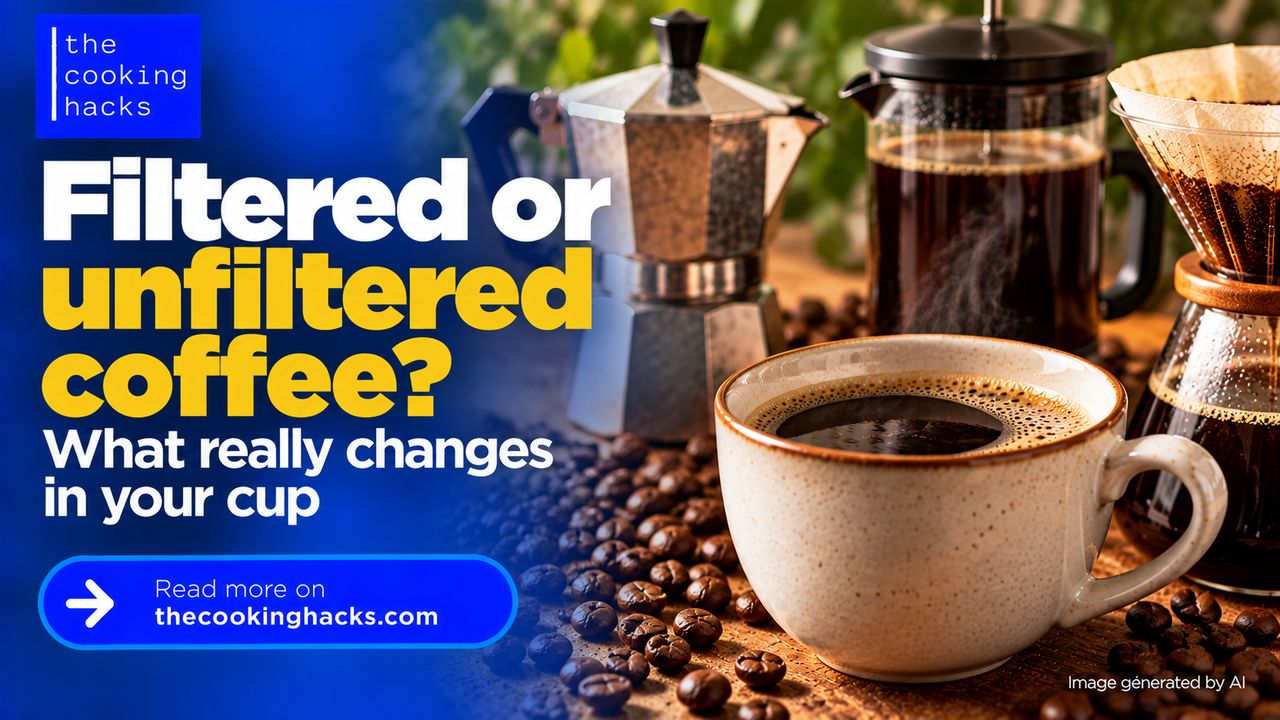
Pour-over, drip coffee, espresso and French press can start with similar roasted coffee beans but produce drinks with different chemical profiles. Brewing method affects more than flavour and strength: it can also change how much of certain compounds from the beans reach your cup.
Two particularly interesting compounds are cafestol and kahweol. A 2025 study comparing brewing methods found low concentrations of these diterpenes in paper-filtered coffee, very high concentrations in boiled coffee, and intermediate or highly variable amounts in several other preparations. The useful takeaway is not that one coffee is universally “healthier”, but that how coffee is brewed really can change what we drink.
What are cafestol and kahweol?
Coffee is chemically complex. Alongside caffeine, chlorogenic acids and aroma compounds, coffee beans contain oils. Cafestol and kahweol are diterpenes associated with this lipid fraction.
Brewing does not transfer every compound from a roasted bean into water in the same way. Grind size, temperature, coffee-to-water ratio, contact time and filtration all affect extraction.
Research comparing paper-filtered, Moka, French press, Turkish and boiled coffee confirms that brewing method can substantially affect how much cafestol and kahweol reaches the finished drink.
Why does a paper filter matter?
The most important distinction here is not simply “filtered versus unfiltered”. Paper filtration is particularly effective at retaining coffee oils and fine particles, and with them much of the cafestol and kahweol.
A metal mesh is therefore not equivalent to a paper filter. A French press has a filter, for example, but its metal screen allows substantially more of the oily fraction to remain in the drink.
A recent assessment of coffee oil and cafestol notes that more than 80% of fatty compounds can be retained by paper filtration, while factors such as water temperature, grind size and coffee-to-water ratio can further affect cafestol levels.
So when a study describes “filtered coffee”, it is worth checking what kind of filter was actually used.
How do drip coffee, French press and boiled coffee compare?
For readers in the US and UK, the clearest comparison is between paper-filtered drip or pour-over coffee and French press or boiled preparations.
Paper-filtered coffee generally contains very little cafestol and kahweol. French press retains more because there is no paper barrier removing most of the oily fraction. Boiled coffee typically sits at the high end.
A study analysing diterpene esters across brewing procedures found boiled and French press coffee among the higher preparations, while filtered coffee contained very low amounts.
This does not mean every cup made by the same method has an identical composition. Coffee variety, recipe and brewing parameters still matter.
What about espresso?
Espresso is a useful example of why simple labels can be misleading. It is not paper-filtered, but its short extraction and small serving size distinguish it from a large cup of boiled or French press coffee.
Studies have also found substantial variability between espresso samples. The 2025 workplace study, for example, recorded some unusually high concentrations, showing why a single number should not be treated as representative of every espresso.
Concentration is not the whole story either. A drink can have a relatively high concentration but be served in a small volume. When thinking about actual intake, both concentration and serving size matter.
Does this mean paper-filtered coffee is healthier?
That conclusion would be too broad. What the evidence supports much more clearly is that paper filtration substantially reduces cafestol and kahweol in brewed coffee.
This matters because cafestol, in sufficient amounts, is known to raise LDL cholesterol. But coffee contains many biologically active compounds, and current research does not justify reducing the overall relationship between coffee and health to a single component.
So “contains less cafestol” is a useful factual comparison. “Healthier coffee for everyone” is a much bigger claim and depends on the person, overall intake and the health outcome being considered.
Is filtered coffee lower in caffeine too?
Not necessarily. Paper filtration and caffeine content are separate issues. The filter is particularly relevant to coffee oils and diterpenes; it does not simply remove the caffeine.
Caffeine intake depends on the beans, amount of ground coffee, extraction and serving size. A large mug of filter coffee and a small espresso therefore cannot be compared just by asking which brewing method is “stronger”.
For most healthy adults, the US FDA cites 400 mg of caffeine per day as an amount not generally associated with negative effects, while also stressing that individual sensitivity varies.
In the UK, pregnancy guidance recommends no more than 200 mg of caffeine a day from all sources, and notes that filter coffee and coffee-shop drinks can sometimes contain more caffeine than standard instant coffee.
Which brewing method should you choose if you want less cafestol?
If reducing cafestol and kahweol is the specific goal, paper-filtered coffee has the clearest advantage in the available measurements.
That does not mean everyone who enjoys espresso or French press needs to change brewing method. How often you drink coffee and how large your servings are also affect total exposure.
For someone drinking several cups each day, switching some of them to paper-filtered coffee would reduce diterpene intake based on the brewing studies. Whether that change is personally relevant from a health perspective is a separate question, particularly for people managing cholesterol or other medical conditions.
Why coffee machines cannot be placed into simple categories
Automatic and workplace coffee machines make the picture even more complicated. Some use filters or brewing systems that remove more oily material than others, and their drinks can vary considerably.
In the 2025 study, coffee from workplace brewing machines generally contained more cafestol and kahweol than paper-filtered coffee but less than boiled coffee. There was also substantial variation between machines.
So seeing the word “machine coffee” tells us relatively little on its own. The brewing mechanism and filtration system matter more than the fact that a machine was involved.
What to remember when choosing how to brew coffee
The clearest practical lesson is that a paper filter changes the composition of coffee, not just how clean the drink looks. It traps much of the oily fraction and greatly reduces the amount of cafestol and kahweol reaching the cup.
French press and boiled coffee generally retain more of these compounds. Espresso can contain more than paper-filtered coffee but is highly variable and is usually consumed in a much smaller serving.
That does not create a universal ranking of brewing methods. It gives us something more useful: an explanation of why changing the way we brew the same everyday ingredient can also change what is actually in the drink.
What is the difference between filtered and unfiltered coffee?
For cafestol and kahweol, the key distinction is usually paper filtration. Paper traps much of the oily fraction of coffee and substantially reduces the amount of these diterpenes in the drink.
Is French press coffee unfiltered?
It is filtered through a metal mesh, but not through paper. As a result, it generally retains more coffee oils and diterpenes than paper-filtered coffee.
Does espresso contain cafestol?
Yes. Levels can vary considerably depending on beans, machine and brewing parameters. Its small serving size also matters when estimating actual intake.
Does paper-filtered coffee contain less caffeine?
Not necessarily. Paper filtration is particularly effective at reducing oils and diterpenes, while caffeine depends on factors including dose, extraction and serving size.
Is paper-filtered coffee healthier than espresso or French press?
Paper-filtered coffee generally contains much less cafestol and kahweol. That specific difference does not by itself establish that one brewing method is universally healthier for every person.
If you don't want to miss the important news, subscribe to The Cooking Hacks Telegram channels:
- Food Recall UK, receive news about food recalls to have a safe pantry
- Offers this week UK, to find out what are the latest offers from supermarkets