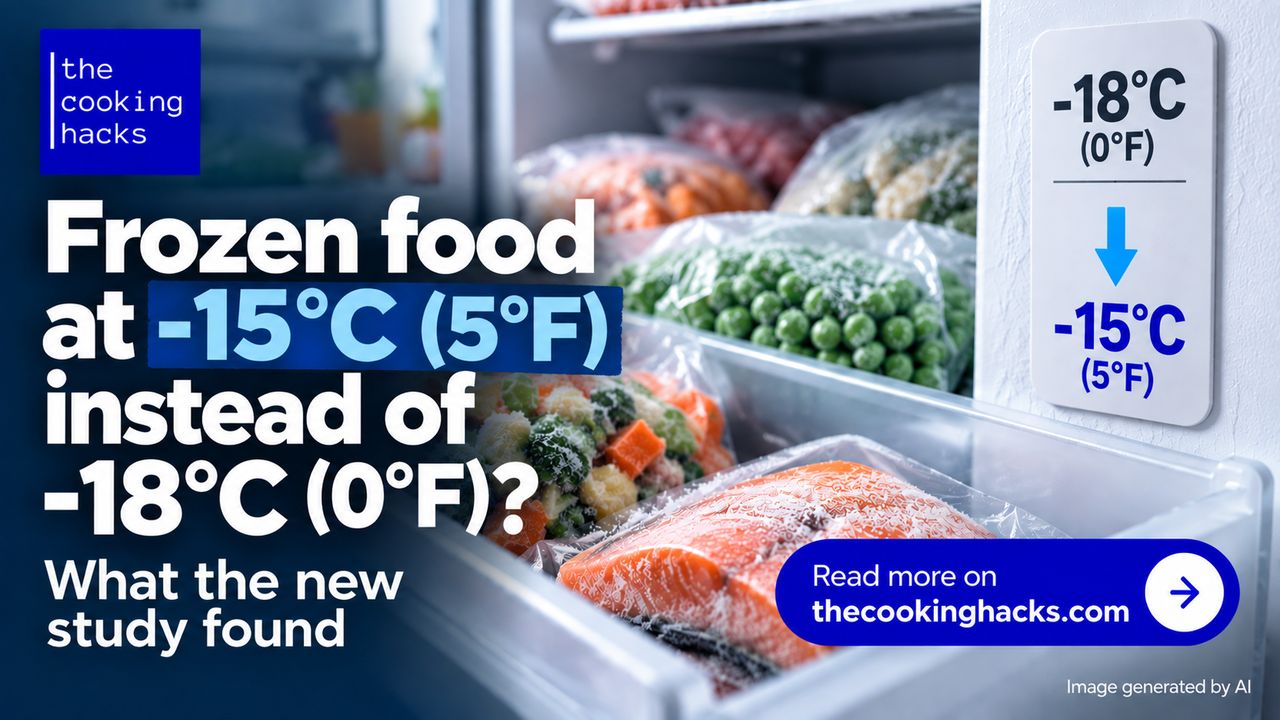
For decades, -18°C (0°F) has been the standard reference temperature for frozen food. Researchers and the frozen-food industry are now investigating whether some products could instead be stored at -15°C (5°F), potentially reducing energy use while maintaining acceptable food quality.
A new study published in npj Science of Food examined nine commercial frozen products, including poultry, fish, salmon, vegetables, pizza and plant-based meat alternatives. The products were stored for up to 18 months at -18°C, -15°C, -12°C and -9°C.
For consumers in both the UK and the US, however, the key point is straightforward: the findings do not mean that household freezers should now be set to -15°C (5°F).
The study measured around 7% lower energy use at -15°C
When the freezer set point was raised from -18°C to -15°C, researchers measured an energy reduction of around 7% under the experimental conditions.
That could become significant across commercial warehouses, cold storage and distribution networks. It should not, however, be interpreted as a guaranteed 7% saving for a domestic freezer, since the result refers to the equipment and conditions used in the experiment.
The idea of raising frozen-food storage temperatures by three degrees is not entirely new. The Three Degrees of Change research from the University of Birmingham has also examined whether moving parts of the frozen-food cold chain from -18°C to -15°C could reduce energy demand while maintaining acceptable food quality.
What happened to food quality at -15°C?
According to the study published in npj Science of Food, for the majority of the quality attributes assessed, including microbial indicators, storage at -15°C did not cause measurements to exceed the acceptance limits used by the researchers.
Sensory quality was more dependent on the individual product. Higher storage temperatures generally accelerated changes in characteristics such as texture, appearance and other sensory properties.
This distinction matters because frozen foods did not all respond in the same way. The results therefore support further assessment on a product-by-product basis, rather than the assumption that every frozen food can simply be stored three degrees warmer.
Should you change your home freezer to -15°C (5°F)?
No. Current consumer guidance in both the UK and the US continues to use approximately -18°C (0°F) as the reference temperature for domestic freezers.
In the United States, the FDA’s food-storage guidance says that a freezer should be kept at 0°F (-18°C) and recommends checking appliance temperatures periodically. The USDA Food Safety and Inspection Service likewise recommends maintaining a freezer at 0°F, equivalent to about -18°C.
The new research therefore concerns a potential evolution of the commercial frozen-food cold chain, rather than a new household recommendation.
For consumers, the practical advice remains unchanged: keep the freezer at around -18°C (0°F) and follow the storage and preparation instructions provided with individual frozen foods.
Who funded the research?
Funding and author affiliations are important context when interpreting the findings. The original research paper includes authors affiliated with Nomad Foods, Wageningen Food & Biobased Research and Campden BRI. The research was funded by Nomad Foods, a company operating in the frozen-food sector, and several authors are affiliated with the business.
That does not make the findings invalid, but it is relevant context when assessing the evidence. The study adds useful experimental data to the debate over whether parts of the frozen-food supply chain could operate at -15°C, but broader changes would require additional evidence, product-specific assessments and consideration of the applicable standards and guidance in individual markets.
If you don't want to miss the important news, subscribe to The Cooking Hacks Telegram channels:
- Food Recall UK, receive news about food recalls to have a safe pantry
- Offers this week UK, to find out what are the latest offers from supermarkets