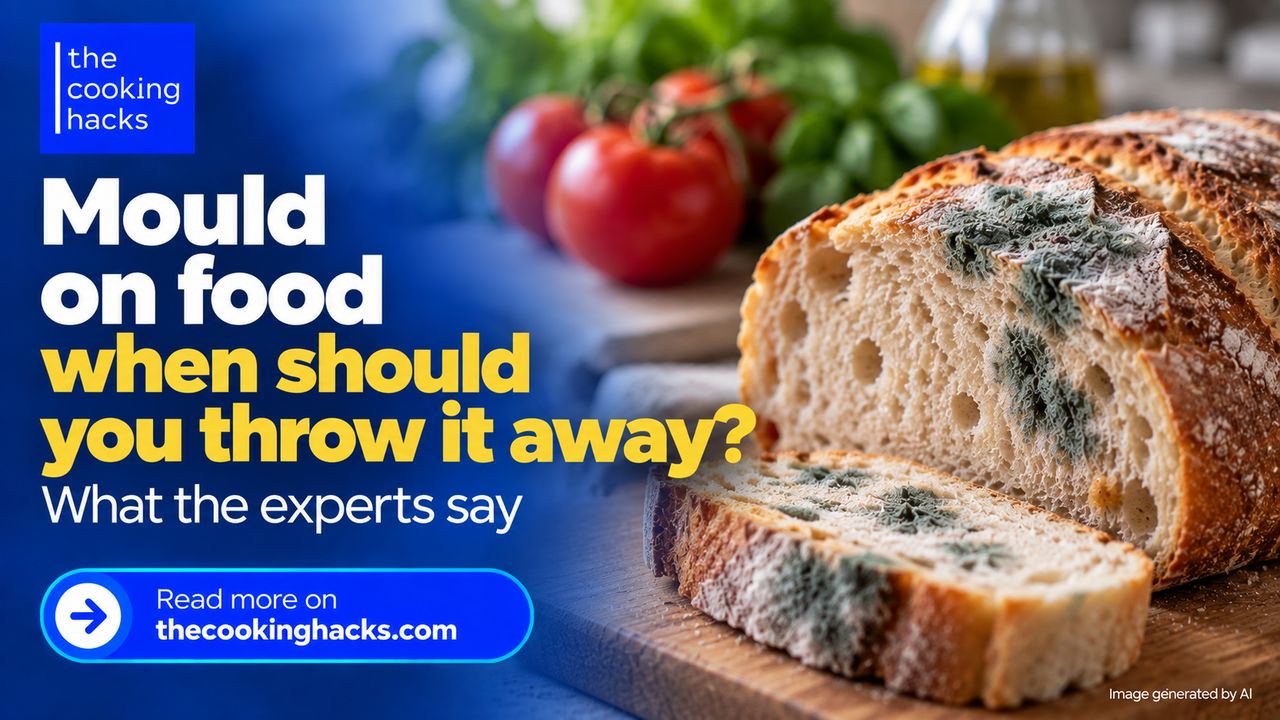
A small patch of mould appears on bread, cheese or fruit. Can you simply cut it away, or should the whole food be discarded? There is no single rule that applies to every kind of food.
Texture and moisture matter. In soft, moist or porous foods, mould can extend below the visible surface, so removing the part we can see may not be enough. With certain firm foods, however, food-safety guidance allows more room for manoeuvre.
There is another important distinction to make. Visible mould, mycotoxins and mould allergy are three different issues. They can be related, but they should not be treated as if they were the same food-safety problem.
Bread and soft foods should not simply be trimmed
Bread is one of the clearest examples of a food where cutting away the visible mould is not a reliable solution.
Mould consists not only of the coloured or fuzzy growth we can see. According to the USDA Food Safety and Inspection Service, root-like threads can penetrate food deeply and, in some cases, toxins may have spread beyond the visibly affected area.
This is particularly important with porous foods such as bread and baked goods and with soft, high-moisture foods. A visible green, white or black patch should therefore not be considered an exact border between the affected and unaffected parts.
The practical consequence is simple: removing one mouldy corner of a slice of bread does not make the rest of it reliably safe to eat.
Hard cheese is where the advice can be different
Firm foods require a more nuanced approach. USDA guidance allows mould to be removed from some hard cheeses such as Cheddar. The recommendation is to cut at least 1 inch, or about 2.5 cm, around and below the mould spot, while keeping the knife out of the mould itself so that it does not contaminate the remaining cheese.
This should not, however, be turned into a general “2.5 cm rule” for every mouldy food. It applies to particular dense foods and does not make the same approach appropriate for bread, soft cheese, yoghurt, jam or other soft and high-moisture foods.
There is also an obvious distinction between unexpected mould and mould that is deliberately used to make a food. Blue cheeses and other mould-ripened cheeses are produced using specific fungal cultures: their characteristic mould is not the same situation as finding unexpected mould growing on food stored in the fridge.
Not every white coating is mould
An unusual appearance does not automatically mean that fungi are growing on a food. Chocolate is a good example. A pale or white coating can be chocolate bloom, caused by changes involving cocoa butter or sugar rather than mould. The Cooking Hacks has already explained why chocolate turns white and whether it is still safe to eat.
Before deciding what to do with an apparently spoiled food, it therefore helps to understand what kind of change has actually occurred.
What do mycotoxins have to do with mould?
Some fungi can produce mycotoxins, but not every mould produces them and the appearance of a mouldy patch cannot tell us whether a particular toxin is present.
The FDA’s information on mycotoxins in food explains that only certain moulds and fungi produce mycotoxins of concern. Among those monitored in human food are aflatoxins, deoxynivalenol, fumonisins, patulin, ochratoxin A, T-2 and HT-2 toxins and zearalenone.
This means two assumptions should be avoided. Seeing mould does not automatically prove that the food contains a dangerous concentration of mycotoxins, but simply scraping away the visible growth does not prove that every potential problem has been removed either.
Mycotoxins can also be an issue before a food ever reaches the domestic fridge. Fungi capable of producing them can grow during crop production or storage, which is why mycotoxin contamination is monitored as part of the food-safety system.
What changes if someone has a mould allergy, including Alternaria?
This is a different question from food spoilage and mycotoxins.
Alternaria alternata is a common environmental mould and is primarily known as an airborne allergen. Sensitisation can cause respiratory symptoms including rhinitis and, in some people, severe asthma.
Allergic reactions following the ingestion of food contaminated with Alternaria appear to be rare, but they have been documented.
A 2026 case report indexed by PubMed described two patients with respiratory allergies who were sensitised to Alternaria alternata. Both experienced anaphylaxis after eating mould-contaminated food. The authors stress that allergic reactions following accidental ingestion of food contaminated with Alternaria have only rarely been reported.
Importantly, the researchers concluded that these reactions were associated with contamination of the food by Alternaria, rather than a conventional food allergy or cross-reactivity between an airborne allergen and a food allergen.
That distinction matters because being allergic to Alternaria does not mean that a person will automatically react to every mouldy food.
For someone with a diagnosed mould allergy, particularly a history of significant reactions, visibly mouldy food should not be used as a home test to find out whether it can be tolerated. Individual risk needs to be assessed with an allergy specialist.
Should you smell mouldy food to check it?
No. Smelling an item is not a useful way of deciding whether mouldy food is safe to eat. USDA advice is specifically not to sniff mouldy food, because doing so can cause respiratory problems. If an item is heavily covered with mould, it should be discarded, and it is also sensible to check foods that were stored next to it because mould can spread, particularly between fruits and vegetables.
This precaution deserves particular attention from people who already have respiratory allergies to mould.
Does having a mould allergy change the general advice?
Yes, and this is one situation in which general advice about salvaging certain firm foods should not simply be applied.
The USDA’s specific advice on allergic reactions to mould states that people who know they are allergic to moulds should discard the entire food item containing mould.
That is stricter than the general USDA guidance that allows the affected part of certain hard cheeses and other firm foods to be removed.
It also shows why allergy should be treated as a separate issue rather than as a footnote to the question of food spoilage.
So when can mould be cut off food?
For soft, moist and porous foods, simply removing the visible mould is generally not a reliable solution because fungal growth may extend beneath the surface.
For certain hard and dense foods, there can be exceptions. USDA guidance, for example, allows a sufficiently large area to be removed from some hard cheeses.
But that exception should not become a universal rule.
The useful principle is therefore: the softer and more porous the food, the less reasonable it is to try to save it by cutting away what you can see.
And for anyone with a known mould allergy, there is an additional consideration. The issue is no longer only whether the food has spoiled or could contain mycotoxins, but also the possibility of an allergic reaction.
FAQ
If one slice of bread is mouldy, can I eat the rest of the loaf?
It is better not to assume the rest of the loaf is unaffected simply because no mould is visible. Bread is porous and fungal growth can extend beyond the part that can be seen.
Can I scrape mould off jam?
Scraping away the surface is not considered a reliable solution for a soft, high-moisture food. The mould can extend beneath the visible area.
Can mould be cut off hard cheese?
For some hard cheeses, USDA guidance allows the mouldy area to be removed by cutting at least about 1 inch, or 2.5 cm, around and below it. This is an exception for particular firm foods, not a general rule for all mouldy food.
Does an Alternaria allergy mean I am allergic to mouldy food?
No. Respiratory sensitisation to Alternaria does not automatically mean that someone will react after eating mould-contaminated food. Rare cases of severe allergic reactions after ingestion of food contaminated with Alternaria have, however, been documented.
Does cooking make mouldy food safe?
Cooking should not be relied upon as a general way to make mouldy food safe. Food-safety concerns can involve more than the living mould itself, including substances produced by certain fungi.
If you don't want to miss the important news, subscribe to The Cooking Hacks Telegram channels:
- Food Recall UK, receive news about food recalls to have a safe pantry
- Offers this week UK, to find out what are the latest offers from supermarkets