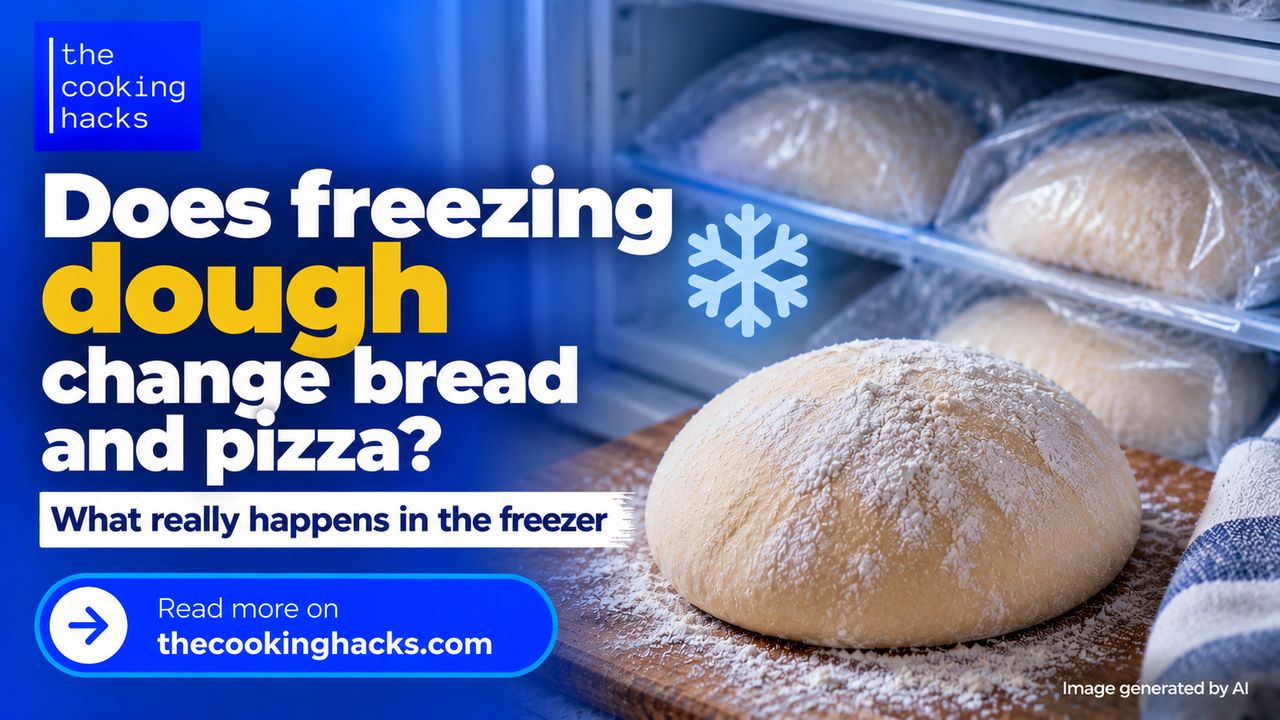
Freezing bread or pizza dough is a convenient way to prepare it in advance, but putting dough in the freezer does more than simply pause it. During freezing and frozen storage, changes can take place in its water, starch and gluten structure. Once the dough is thawed and baked, these changes may contribute to lower volume, reduced elasticity and a firmer or less even texture.
Starch is the main focus of a new review published in Food Chemistry, available online since September 13, 2026. The authors examined research into how wheat starch granules deteriorate during frozen storage and how starch interacts with water, gluten and other components of the dough. Much of this research, however, comes from laboratory and industrial frozen-dough systems, so its findings should not automatically be turned into rules for homemade pizza or bread.
What happens to dough when it freezes?
Dough is a complex system. Water interacts with starch and gluten proteins, while yeast adds another important component in leavened doughs. When the temperature falls sufficiently, some of that water freezes and forms ice crystals.
The formation and subsequent recrystallisation of ice can alter the way water is distributed through the dough and place mechanical stress on its structure.
The new review focuses particularly on wheat starch. Wheat contains different populations of starch granules, commonly described as A-type and B-type granules, which differ in size and other characteristics. Freezing can affect them differently while also changing the relationship between starch, water and the gluten network.
The process extends beyond starch. An earlier review of deterioration mechanisms in frozen dough also examined gluten proteins, yeast and lipids, as well as the effects of freezing, storage and thawing. Together, these factors help determine how frozen dough performs after it is thawed.
Why can frozen dough produce smaller bread or pizza?
The gluten network gives dough the ability to retain the gas generated during fermentation. If freezing weakens that network, the dough may become less effective at holding carbon dioxide. Freezing can also affect yeast cells in leavened dough.
After thawing, proofing and baking, the final product may therefore have less volume, greater hardness or a less uniform internal structure.
That does not mean every ball of pizza dough stored in a home freezer will show the same effects. Dough formulation, freezing rate, storage time and temperature fluctuations can all influence the outcome.
Temperature stability is particularly interesting. A 2026 study indexed by PubMed compared conventional frozen storage with an experimental system designed to buffer temperature changes over 60 days. The more stable conditions reduced ice recrystallisation and mechanical damage to the gluten-starch network and yeast cells. Bread produced from dough stored under those experimental conditions had a 15.69% higher specific volume than the comparison group. This was a controlled study, however, rather than a test of ordinary household freezers.
Does that mean you should not freeze pizza dough?
No. The research does not show that freezing dough is something to avoid. Instead, it helps explain why frozen and fresh dough may not behave in exactly the same way.
Ice formation, water migration and changes to starch, gluten and yeast can all contribute. This means that a difference in texture or rise after thawing is not necessarily caused by a single factor.
For home cooks, that distinction matters. Research on frozen dough can help explain why a thawed dough might feel less elastic or produce a loaf with less volume, but it cannot predict exactly what will happen to every homemade recipe.
TCH’s guide to fresh yeast also explains its role in producing the carbon dioxide that allows bread dough to rise, an important part of understanding why changes affecting yeast and gas retention can influence the final result.
Industrial solutions are not automatically home-kitchen hacks
Researchers have investigated many ways to limit deterioration in frozen dough. These include selecting different raw materials, modifying starch properties, using protective additives, improving yeast freeze tolerance and controlling freezing technology.
Many of these approaches are intended for industrial processing or laboratory research, rather than the home kitchen. The new review itself notes an important limitation: much of the available evidence comes from laboratory-scale experiments carried out under tightly controlled frozen-storage conditions. Real production, transport and use can involve temperature fluctuations and different thawing procedures.
So the practical takeaway is deliberately modest. Dough can be frozen, but freezing is a physical process that can change its internal structure and therefore its performance after thawing and baking. The new research helps explain those changes; it does not provide a universal formula for making homemade frozen dough behave exactly like fresh dough.
FAQ
Does freezing pizza dough ruin it?
Not necessarily. Freezing can cause structural changes that affect texture and volume, but the extent of those changes depends on the recipe and on freezing, storage and thawing conditions.
Why might frozen dough rise less after thawing?
Research points to several possible mechanisms, including damage to the gluten network and effects on yeast cells. Both can reduce the dough’s ability to produce or retain gas efficiently.
Do ice crystals damage dough?
They can contribute to deterioration. Ice formation and recrystallisation affect water distribution and can place mechanical stress on the gluten-starch structure.
Does the new research directly apply to homemade pizza dough?
Only with caution. The mechanisms are relevant to wheat dough, but much of the evidence reviewed comes from laboratory or industrial frozen-dough systems rather than household freezers.
If you don't want to miss the important news, subscribe to The Cooking Hacks Telegram channels:
- Food Recall UK, receive news about food recalls to have a safe pantry
- Offers this week UK, to find out what are the latest offers from supermarkets