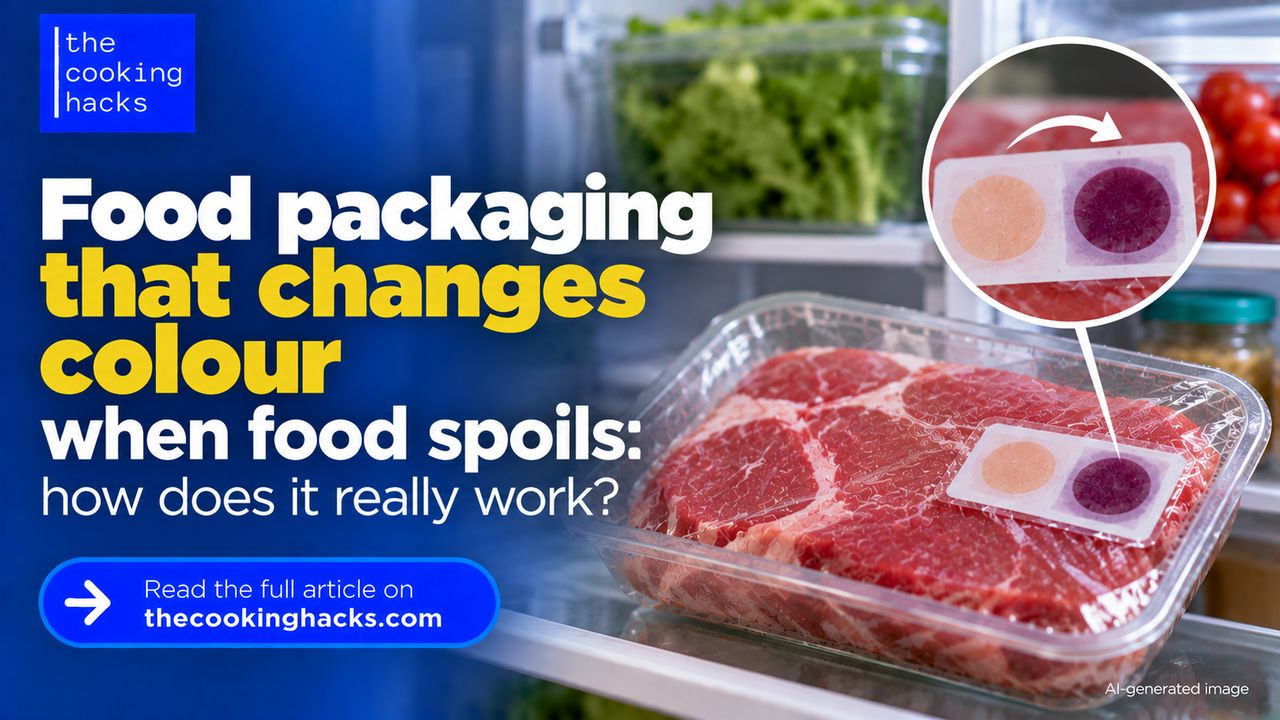
A package that changes colour as food loses freshness sounds futuristic, but this is one of the technologies being investigated for intelligent food packaging. From a consumer’s perspective, the basic idea is straightforward: an indicator inside the package responds to certain changes associated with food spoilage and turns them into a visible signal.
A review published in Food Chemistry on 13 September 2026 examines developments in colour-changing hydrogel indicators from 2016 to 2026. The aim is not simply to create a label that declares food “good” or “bad”. Instead, these systems are designed to make specific changes associated with food deterioration visible.
Why can a freshness indicator change colour?
As food deteriorates, microbial activity and chemical processes can produce different compounds or change conditions inside the package.
A hydrogel can act as a porous support for a sensing component. When the targeted substance or condition changes, the system converts that change into a colour that can be seen by the consumer. In principle, this provides information without opening or damaging the package.
There is no single way to do this. Some indicators respond to changes in pH, while others target particular compounds associated with spoilage. That is also why there is no universal sensor that can simply be attached to every type of food.
Meat, seafood, dairy and produce need different indicators
With meat and seafood, one approach is to detect volatile compounds associated with protein degradation. As these compounds change, an appropriately designed indicator can respond with a visible colour shift.
Dairy products can involve pH changes, while systems designed for fruit and vegetables may monitor particular volatile organic compounds. The 2026 review therefore stresses that sensing strategies have to be tailored to the biochemical characteristics and spoilage pathways of the food being monitored.
What would consumers actually see?
In its most intuitive form, the technology could appear as a small indicator or area of the package that changes colour as the monitored condition changes. Instead of relying only on a printed date, consumers could potentially receive additional information about the condition of the food itself.
EFSA describes intelligent food-contact materials as materials that monitor the condition of packaged food or its surrounding environment, for example by providing information about freshness or the temperature inside a package.
Does a colour change mean the food is unsafe?
Not necessarily. An indicator responds to the parameter or compounds it was designed to detect. A colour change can therefore provide information about that particular process, but it should not automatically be interpreted as a complete microbiological safety test.
The reverse is also important. A particular colour should not be treated as an absolute guarantee that food is safe unless the system has specifically been validated to support that conclusion. Freshness, spoilage and microbiological safety are related concepts, but they are not interchangeable.
Why aren’t colour-changing indicators on every food package yet?
A laboratory prototype also has to work reliably during manufacturing, transport, storage and retail. The indicator needs to remain stable, react within a useful amount of time and be sensitive enough without becoming impractical or too expensive.
The review identifies sensitivity, response time, stability and cost among the main challenges still facing these technologies. Researchers are also exploring multi-analyte sensors and ways to combine these systems with digital technologies.
For consumers, the interesting prospect is therefore not a package that makes the decision about whether food is safe to eat. It is a package that could provide another piece of information about what is actually happening to the product inside, using something as easy to understand as a change in colour.
How can food packaging change colour when food spoils?
An indicator incorporated into the packaging can respond to specific chemical changes or compounds associated with deterioration and convert that response into a visible colour change.
Can the colour tell you whether food is still fresh?
It can provide information about the specific condition or compound the sensor was designed to monitor. There is no universal indicator for every food.
Does a colour change mean food is unsafe to eat?
Not automatically. It indicates a change in the parameter being monitored and is not necessarily equivalent to a complete microbiological safety assessment.
Are colour-changing food packages already available?
Various intelligent packaging technologies exist, but many of the hydrogel colour indicators discussed in current research are still being developed and validated. Large-scale commercial use still faces technical and economic challenges.
Can the same indicator be used for meat, dairy and fruit?
Not necessarily. Different foods produce different chemical signals as they deteriorate, so sensing systems need to be designed for the food and target being monitored.
If you don't want to miss the important news, subscribe to The Cooking Hacks Telegram channels:
- Food Recall UK, receive news about food recalls to have a safe pantry
- Offers this week UK, to find out what are the latest offers from supermarkets