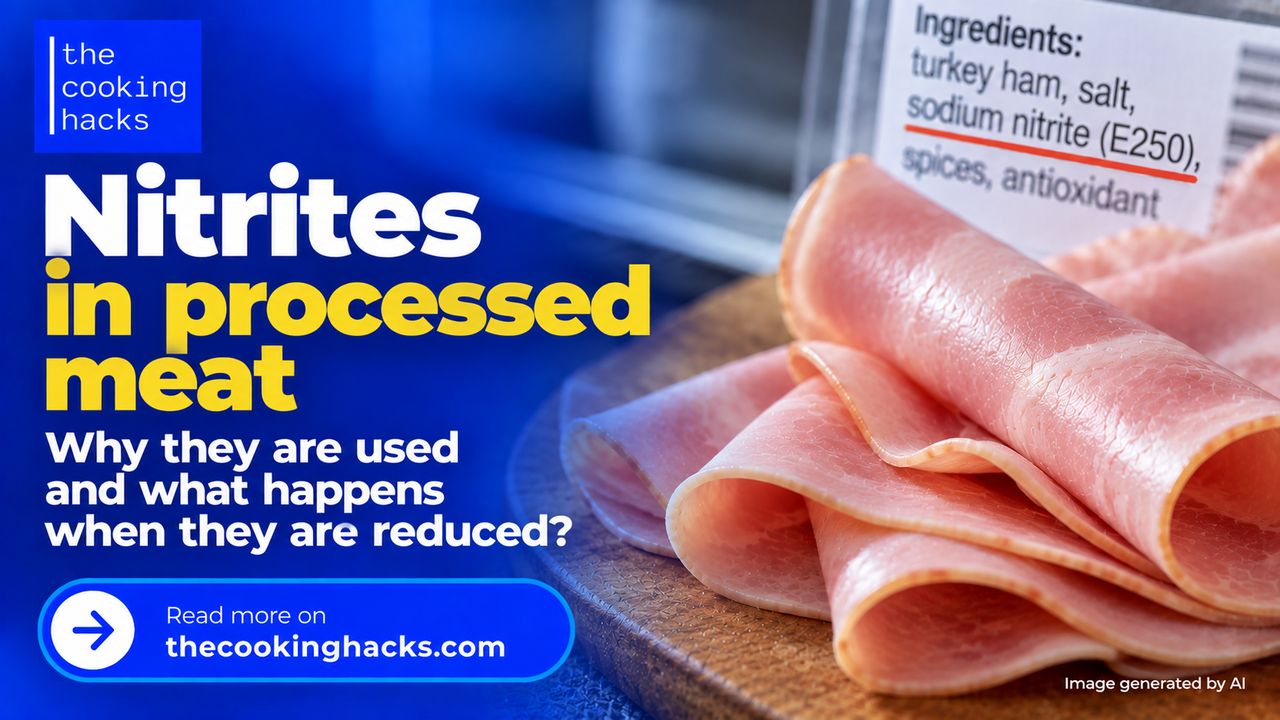
Look at the ingredients on ham, bacon or other cured meats and you may find sodium or potassium nitrite. It can be tempting to see these additives simply as something that would be better removed, but their role is more complicated: nitrites help preserve cured meat as well as contributing to its familiar colour and flavour.
A study published in Frontiers in Food Science and Technology on September 9, 2026 provides a useful example. Researchers compared different formulations of cooked turkey ham, including one made with 150 mg/kg of added sodium nitrite and another with 119 mg/kg. Under the conditions tested, the lower-nitrite formulation performed comparably during the 28-day commercial shelf life examined. That does not mean the same reduction would work for every type of processed meat.
Why are nitrites added to cured meat?
Part of the answer is easy to see and taste. Nitrite helps produce the characteristic colour of cured meats and contributes to their flavour.
Its less visible role is particularly important: it helps control dangerous microorganisms, including Clostridium botulinum, which can cause botulism. The US Department of Agriculture explains the role of nitrites in controlling C. botulinum in cured meat products.
A 2026 scientific review of strategies to reduce or replace nitrites and nitrates in processed meat found that lower levels may be possible in some products, but their effectiveness depends on both the food and the microorganism that needs to be controlled. In other words, there is no single lower amount that can simply be applied to every processed meat.
Why try to reduce nitrites, then?
One concern is what can happen to nitrites through chemical reactions. Under certain conditions, they can contribute to the formation of nitrosamines, a group that includes compounds of concern for human health.
This creates a balancing act. Researchers and food manufacturers want to understand whether less nitrite can be used without weakening the controls that help keep food safe.
For the UK, a Food Standards Agency evidence review on the safety of nitrates and nitrites as food additives examined research published between 2016 and 2024. The review considered both their antimicrobial role and concerns surrounding the formation of nitrosamines.
The important point for shoppers is that the question cannot be reduced to “nitrites are good” or “nitrites are bad”. Their use has benefits for food preservation, while their reduction is being studied because of concerns linked to some of the compounds that can form from them.
What did the turkey ham study actually find?
For this particular product, reducing added sodium nitrite from 150 to 119 mg/kg produced comparable results over the 28-day commercial shelf life studied.
The researchers also carried out specific tests involving Listeria monocytogenes. Its growth remained limited in the reduced-nitrite formulation at 4°C (39°F), but the results changed when the product was stored at 8°C (46°F), where a temporary increase was observed.
That detail is useful beyond this particular experiment because it shows why food safety depends on the whole system. The recipe matters, but so do manufacturing conditions, storage temperature and time.
We have seen the same principle when looking at what happens when the storage temperature of frozen food is changed: changing one part of a food preservation system does not make all the other conditions irrelevant.
Does less nitrite automatically mean safer food?
No. Removing or reducing an additive that also helps control microorganisms means manufacturers have to make sure that protection is maintained in the reformulated product.
There is also an important limitation to the new turkey ham study: the researchers did not measure nitrosamines. The experiment therefore cannot tell us whether reducing sodium nitrite from 150 to 119 mg/kg actually reduced nitrosamine formation in that product.
There are also differences between markets. Rules and permitted uses in Great Britain and the United States are not necessarily identical, so the amount tested in one European product should not be read as a universal target for processed meat everywhere.
For shoppers, the useful conclusion is therefore more nuanced than simply looking for the shortest possible ingredients list. The presence or absence of nitrite alone cannot tell us whether one processed meat is safer than another. What matters is how the entire product has been formulated, manufactured and stored.
What does sodium nitrite do in processed meat?
It helps control certain dangerous microorganisms, including Clostridium botulinum, while also contributing to the characteristic colour and flavour of cured meats.
Is nitrite-free processed meat automatically safer?
No. The absence of nitrite alone does not establish that a product is safer. Other ingredients, processing methods and preservation controls also matter.
Why are food manufacturers trying to reduce nitrites?
One reason is concern about chemical reactions that can lead to the formation of nitrosamines. Research is examining how nitrites can be reduced while maintaining microbiological safety.
Does the new study prove that all processed meats can use less nitrite?
No. It tested a particular cooked turkey ham formulation under specific manufacturing and storage conditions. Its results cannot automatically be applied to other products.
If you don't want to miss the important news, subscribe to The Cooking Hacks Telegram channels:
- Food Recall UK, receive news about food recalls to have a safe pantry
- Offers this week UK, to find out what are the latest offers from supermarkets