Most of us do not stop to make a food-safety decision every time we open the fridge. We find an empty space and put the food there. A 2026 study published in Food Research International suggests this gap between knowledge and everyday behaviour matters: people can have positive attitudes towards safe food storage while still organising their refrigerators incorrectly.
The study surveyed 242 Italian consumers, so its behavioural findings should not be treated as representative of UK or US households. Its broader finding is nevertheless useful: intentions were strongly related to factors including perceived behavioural control — essentially whether people feel able to perform the behaviour in practice. The researchers also identified egg placement as an area deserving clearer communication. The research is also indexed on PubMed.
For readers, that leads to a practical question: rather than memorising a complicated diagram, can we organise the fridge so that the safer choice becomes the easiest choice?
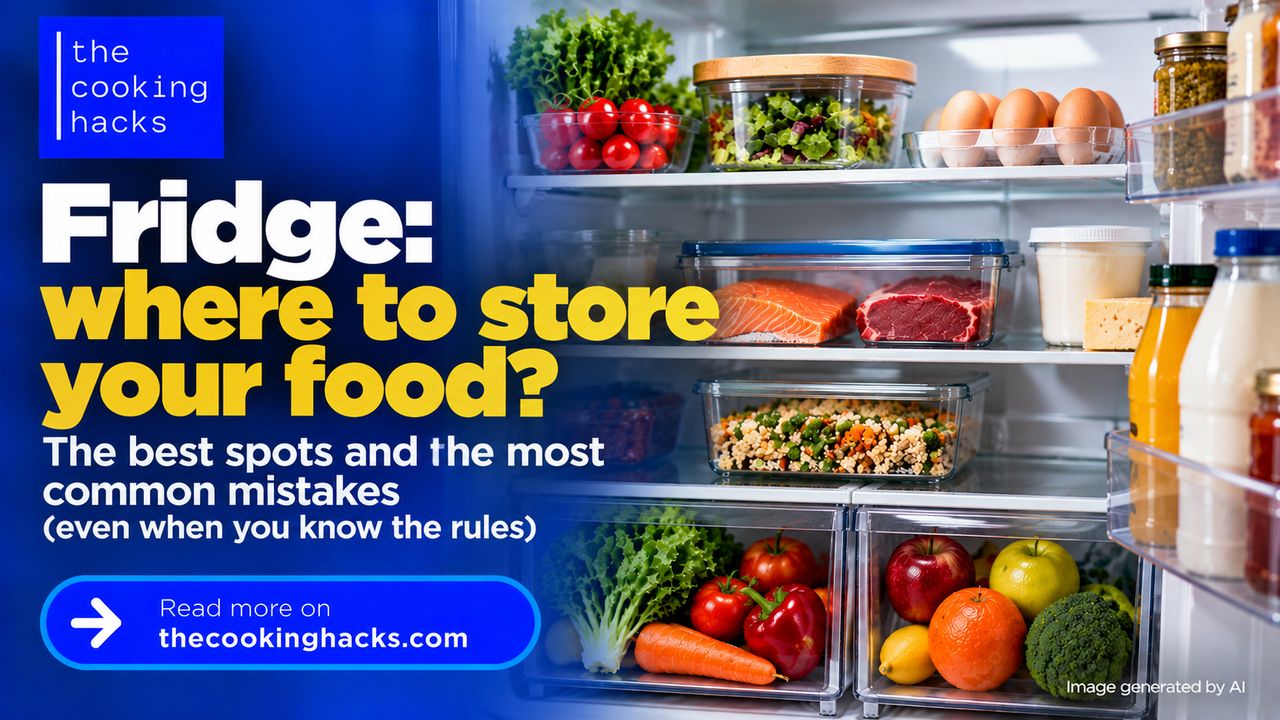
Raw meat and poultry need to be kept away from ready-to-eat food
One of the most important principles is separation. Raw meat, poultry and seafood can contain microorganisms, and their juices should not reach foods that may be eaten without further cooking. That is why keeping raw food contained and away from ready-to-eat products matters more than creating a perfectly arranged fridge.
UK research also suggests that available space can influence behaviour. The Food Standards Agency’s review of refrigerator-storage research notes that people may put foods wherever space is available rather than following recommended storage arrangements, which can make correct separation harder in a crowded fridge. The FSA’s Kitchen Life 2 literature review examines these household practices.
What UK data tell us about everyday habits
The Food Standards Agency’s 2026 review of home food-safety practices brings together self-reported behaviour from 2020 to 2025 across areas including cross-contamination, chilling and use-by dates. Most of the behaviours examined remained relatively stable over the period.
These data are important to interpret correctly: they describe what respondents say they do and cannot be used to establish changes in rates of foodborne disease or a causal relationship between individual behaviours and illness.
Eggs show why UK and US guidance cannot simply be merged
Egg storage is a particularly useful example of why an international article cannot apply one country’s advice everywhere. In the United States, FoodSafety.gov advises keeping eggs in their original carton in the main compartment of the refrigerator, not in the door.
That US recommendation should not simply be copied to every market. Production practices, retail storage and official advice differ between countries. The practical rule for an international reader is therefore to follow the storage instructions applicable where the eggs were purchased.
Do not assume every refrigerator has the same coldest shelf
Temperature distribution depends on appliance design. A diagram showing the bottom, middle and top shelves as fixed temperature zones may work for one refrigerator and be misleading for another.
What matters is keeping the appliance at the recommended temperature, checking the manufacturer’s instructions for any designated cold zone and using compartments for their intended purpose. Highly perishable foods need reliable refrigeration, while produce may have different requirements depending on the fruit or vegetable and its stage of ripeness.
Fruit does not automatically belong in the fridge
Refrigeration can slow deterioration, but not every fruit should go straight into the fridge after shopping. Some fruits benefit from cold storage, while others should first ripen at room temperature. We explain these differences in our guide to where to store fruit and when it makes sense to move it into the fridge.
This is also why “put all produce in the crisper drawer” is too simplistic. The useful question is not only where an item fits inside the fridge, but whether it needs refrigeration at that stage at all.
Make safe storage easy enough to become automatic
The behavioural side of the 2026 study offers perhaps the most useful lesson. Information alone does not necessarily change habits. The researchers found that intentions were influenced by how much control people felt they had over carrying out the behaviour, as well as desire and anticipated positive emotions.
In practical terms, that argues for making the fridge easy to use: give raw meat and poultry a fixed safe area, keep ready-to-eat foods separate, leave enough room to see what you have and keep foods that need using first visible rather than buried at the back.
The goal is not a perfect-looking refrigerator. It is to remove small everyday decisions that make correct storage easy to forget. Once each type of food has a logical place, putting groceries away becomes a routine rather than a food-safety test.
FAQ
Where should raw meat and poultry be stored in the fridge?
They should be contained so that juices cannot contaminate other foods and kept separate from cooked and ready-to-eat products. In the UK, bottom-shelf storage is commonly recommended to reduce the risk of drips reaching foods below.
Should eggs be kept in the refrigerator door?
Advice differs by market. In the United States, official guidance says to keep eggs in their original carton in the main compartment rather than the door. Follow the guidance applicable where the eggs were purchased.
Why should raw and cooked foods be kept separate?
Separation helps prevent microorganisms or juices from raw foods reaching cooked or ready-to-eat foods that may not undergo another cooking step.
Is the bottom of every refrigerator the coldest part?
Not necessarily. Temperature distribution varies according to appliance design, so the manufacturer’s instructions should be checked.
Why does fridge organisation matter if everything is refrigerated?
Because refrigeration is only one part of safe storage. Organisation also helps prevent cross-contamination, maintain suitable storage conditions and make it easier to use food before it is forgotten.
If you don't want to miss the important news, subscribe to The Cooking Hacks Telegram channels:
- Food Recall UK, receive news about food recalls to have a safe pantry
- Offers this week UK, to find out what are the latest offers from supermarkets