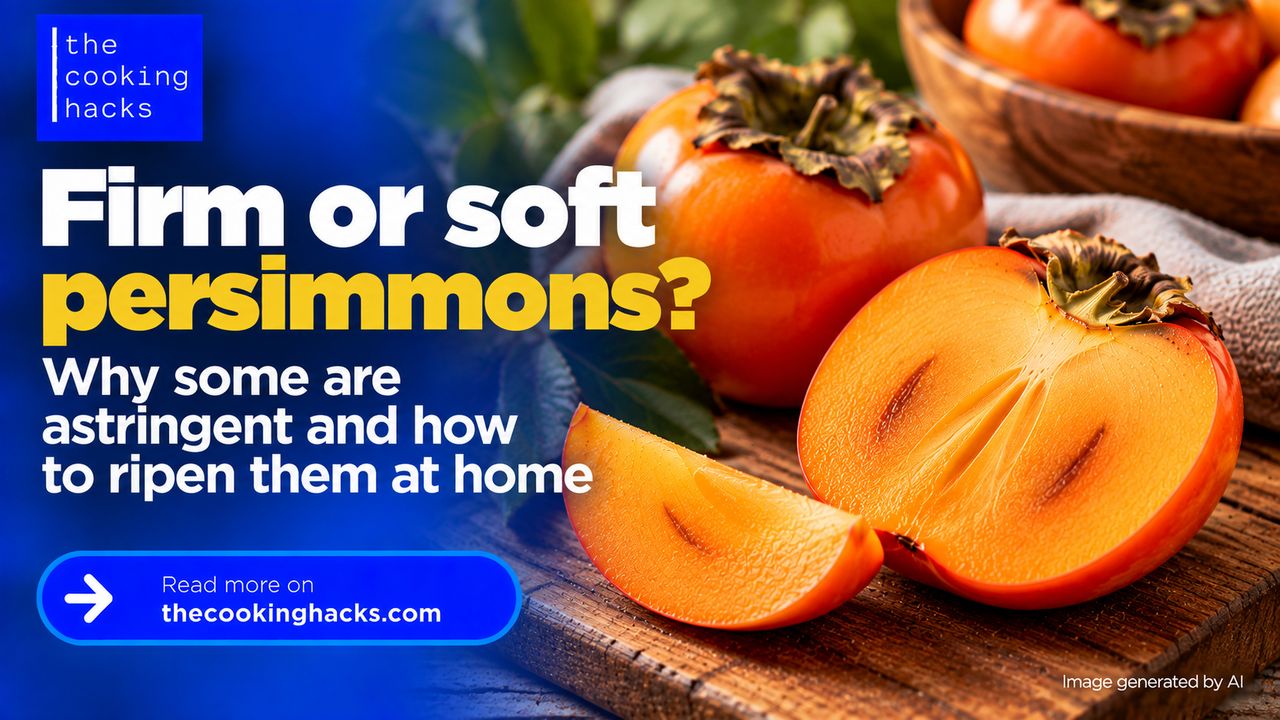
Biting into the wrong persimmon at the wrong stage can leave your mouth feeling instantly dry and puckered. But a firm persimmon is not necessarily unripe, and a very soft one is not necessarily past its best. The difference largely depends on the cultivar and whether it is astringent or non-astringent.
Understanding that distinction makes shopping for persimmons much easier and can prevent perfectly usable fruit from being thrown away simply because it is not ready to eat yet.
Why do some persimmons make your mouth feel dry?
That distinctive puckering sensation is called astringency. It is mainly associated with soluble tannins in the fruit, which interact with proteins in saliva and create the dry, rough sensation in the mouth.
Research on persimmon astringency and tannins shows a strong relationship between tannin characteristics and the way astringency is perceived.
The important detail for shoppers is that persimmon cultivars do not all lose their astringency in the same way.
Astringent and non-astringent persimmons are different
The simplest useful distinction is between astringent and non-astringent cultivars.
Fuyu, widely sold in the US, is a familiar non-astringent persimmon. It can be eaten while still firm and crisp. Hachiya is the classic astringent example: unless its astringency has been removed in another way, it normally needs to become extremely soft before it is pleasant to eat.
Research comparing astringent and non-astringent persimmon cultivars during ripening found different patterns of tannin insolubilisation. This helps explain why a crisp persimmon can be perfectly edible while another fruit with a similar firmness can still be intensely astringent.
How can you tell Fuyu and Hachiya apart?
Shape can provide a useful clue when the cultivar is not clearly labelled. Fuyu persimmons are typically squat and relatively flat, rather like a small orange tomato, while Hachiya fruit tend to be more elongated or acorn-shaped.
University of California guidance notes that Fuyu can be eaten crisp, whereas Hachiya needs to become very soft before eating.
Shape is useful, but a label identifying the cultivar is better when available because there are many persimmon varieties beyond these two.
Why can some astringent persimmons still be sold firm?
Because firmness and astringency are related but not identical properties.
Commercial producers can use controlled post-harvest treatments to remove astringency while keeping the fruit relatively firm. High-concentration carbon dioxide is one established commercial approach.
Studies of CO₂ deastringency treatment in persimmons show that soluble tannins can be reduced as a source of perceived astringency without requiring the fruit to reach the extremely soft stage associated with natural ripening.
This is why squeezing a persimmon cannot always tell you its entire story.
What actually changes as a persimmon ripens?
Several things happen at once. The fruit changes colour, the flesh generally softens and its chemical composition continues to evolve.
For astringency, one of the important factors is the amount of tannin remaining in a soluble form. A 2026 study of post-harvest astringent persimmons used both firmness and soluble tannin content to follow changes during storage.
The two are related to post-harvest development, but that does not make them the same measurement. A softening persimmon is undergoing several changes at the same time, and loss of astringency is only one of them.
How do you ripen a hard Hachiya persimmon at home?
The simplest method is patience. Leave an astringent persimmon at room temperature and allow it to continue ripening naturally.
For Hachiya in particular, the change can be dramatic: a fruit that initially feels firm eventually becomes extremely soft, with an almost jelly-like interior. UC Master Food Preserver guidance describes natural room-temperature ripening as the simplest way to make astringent Hachiya ready to eat.
At that point, the flesh can be scooped out with a spoon or used in baking and desserts.
Can an apple or banana help a persimmon ripen faster?
Yes. Persimmons are sensitive to ethylene, a natural plant hormone involved in fruit ripening. Keeping a persimmon close to ethylene-producing fruit such as apples or bananas can speed the process.
UC Davis post-harvest guidance reports that persimmons respond strongly to ethylene exposure, particularly through faster softening.
There is no reliable household rule saying that every persimmon will be ready after a fixed number of days. Cultivar, starting maturity and room temperature all make a difference, so checking the fruit daily is more useful than following a countdown.
Should persimmons be kept on the counter or in the fridge?
It depends on your goal. If an astringent fruit is still firm and you want it to ripen, room temperature makes more sense. Refrigeration can be useful once the fruit reaches the stage you want and you need to slow further change.
Non-astringent Fuyu can be eaten crisp or soft and can be refrigerated to maintain firmness. Astringent Hachiya, by contrast, is often allowed to soften dramatically before it is eaten.
The practical rule is therefore: counter for ripening, refrigeration for slowing things down.
Is an extremely soft persimmon spoiled?
Not necessarily. This is one of the easiest mistakes to make with astringent persimmons.
A ripe Hachiya can become extremely soft, almost translucent and jelly-like. That texture can be exactly what you are looking for rather than evidence that the fruit has spoiled.
Normal ripening should still be distinguished from actual deterioration. Visible mould, rotten areas or an abnormal smell are different signals and should not be dismissed simply because very soft flesh can be normal for the cultivar.
What should you remember when buying persimmons?
Do not use firmness as your only test. A firm persimmon can be ready to eat, while another firm persimmon may still need considerable ripening.
If the label says Fuyu, you can generally expect a non-astringent fruit that can be eaten crisp. If it is Hachiya, natural ripening usually means waiting until it becomes very soft unless the fruit has already undergone a commercial deastringency process.
And if an astringent persimmon makes your mouth pucker, it does not necessarily belong in the bin. Giving it more time at room temperature — optionally near apples or bananas — may be all it needs.
Why do persimmons make your mouth feel dry?
The sensation is mainly caused by soluble tannins interacting with proteins in saliva. It is known as astringency.
Can you eat a persimmon while it is still firm?
Yes. Non-astringent cultivars such as Fuyu can be eaten crisp. Firmness alone does not tell you whether every persimmon is ready to eat.
How can I ripen a persimmon faster?
Keep it at room temperature, optionally near an apple or banana. Ethylene from other fruit can accelerate ripening and softening.
Why are some firm supermarket persimmons not astringent?
They may be naturally non-astringent cultivars, or an astringent cultivar may have undergone a controlled commercial deastringency treatment after harvest.
Is a very soft Hachiya persimmon spoiled?
Not necessarily. Hachiya normally becomes extremely soft and almost jelly-like when fully ripe. Look separately for genuine signs of spoilage such as mould, rotten tissue or abnormal odours.
If you don't want to miss the important news, subscribe to The Cooking Hacks Telegram channels:
- Food Recall UK, receive news about food recalls to have a safe pantry
- Offers this week UK, to find out what are the latest offers from supermarkets