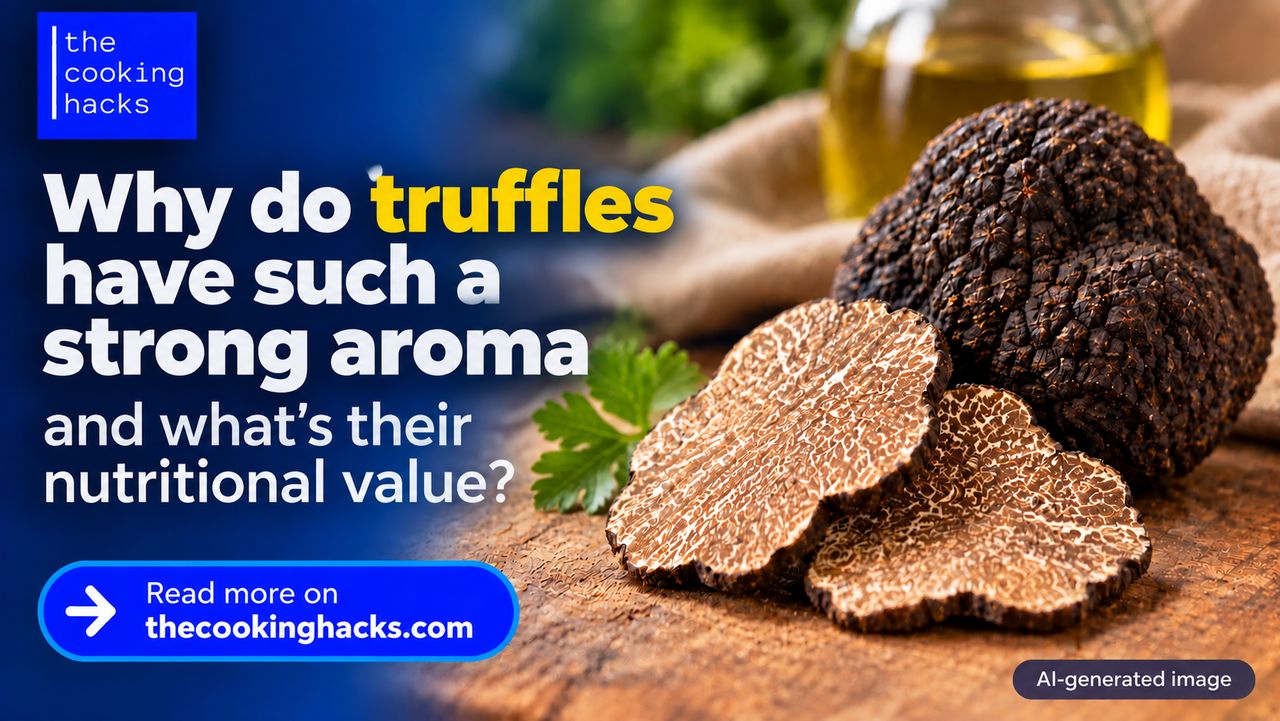
Truffle aroma comes from a complex mixture of volatile compounds, but not all of them contribute equally to the smell we experience. Some substances can have a powerful effect even at extremely low concentrations. Truffles also contain protein, fibre and minerals, yet the small amounts typically eaten mean their nutritional contribution is limited. A scientific review published in 2026 explains what researchers know about these characteristics and where important gaps remain.
What makes truffles smell so distinctive?
Truffles release volatile aroma compounds that reach our noses and create their characteristic aroma. However, the concentration of a compound does not necessarily tell us how important it is to the overall smell.
A 2026 critical review published in European Food Research and Technology by Fausta Natella, Innocenzo Muzzalupo and Antonio Raffo reports that approximately 300 volatile compounds have been identified in truffles, but only a few dozen have been recognised as odour-active.
This distinction matters because some compounds can be detected by the human nose at extremely low concentrations. Others may be present in much larger amounts without making a comparable contribution to the perceived aroma.
Scientists therefore need more than a chemical list of volatile substances to explain how a truffle actually smells. Sensory testing and techniques that combine chemical analysis with human smell perception are also necessary.
Why do white and black truffles smell different?
Different truffle species have distinct aroma profiles, created by combinations of aroma-active compounds. This means there is no single smell that describes every truffle.
In the highly prized Alba white truffle, Tuber magnatum, research has identified bis(methylthio)methane, also known as 2,4-dithiapentane, as an important contributor to its strong sulphurous, garlic-like aroma.
The Périgord black truffle, Tuber melanosporum, has a different profile, with sensory descriptions that include mushroom-like, sulphurous and black-olive notes. Burgundy truffles, Tuber uncinatum, have been associated with mushroom-like and cabbage-like notes in specific sensory studies.
These descriptions reflect the findings of particular studies rather than a guarantee that every truffle of the same species will smell identical. Individual samples can vary, and storage or processing can also influence the final aroma.
Does a stronger smell mean a better truffle?
Not necessarily. Aroma intensity is only one aspect of the sensory experience. The character of the aroma, the balance of different notes and how closely they match the expected profile of the species also matter.
The review highlights a surprising limitation in truffle research: despite their high culinary and economic value, relatively few studies have used standardised quantitative sensory analysis to describe their aromas.
For several species, researchers still lack a comprehensive and consistently defined set of aroma descriptors. Measuring the number or concentration of volatile compounds therefore cannot, on its own, establish how good a truffle will smell to a consumer.
What is the nutritional value of truffles?
Truffles contain water, protein, dietary fibre, small amounts of fat and various minerals. Their exact composition depends on the species, and available truffle nutrition data are not always complete or directly comparable.
For the Périgord black truffle, Tuber melanosporum, the review examines food composition data from France, Italy and Spain. These indicate average values of approximately 7 g of protein and 0.5 g of fat per 100 g of fresh truffle. The French and Italian tables also report approximately 8.4 g of fibre per 100 g.
However, 100 g is much more than the amount of truffle typically added to an individual dish. The review notes that Italian food composition tables use a standard truffle portion of 5 g, or approximately 0.18 oz.
At that serving size, the average figures reported for black truffle correspond to approximately 0.35 g of protein and 0.42 g of fibre. These amounts illustrate why a food can have an interesting composition per 100 g while contributing relatively little to a normal meal.
Do truffles provide important vitamins and minerals?
Truffles contain minerals such as potassium, phosphorus and calcium, along with certain vitamins. However, the available evidence is fragmented, and some nutrients have been measured in only a limited number of studies or species.
Even when a nutrient is present in measurable quantities per 100 g, the small amount of truffle normally eaten means its actual contribution to dietary intake is generally modest.
Researchers also lack sufficient information about truffle protein digestibility and amino acid composition to make firm conclusions about protein quality across different species.
How can you make the most of truffle aroma when cooking?
Truffles are primarily valued for their aroma rather than their nutritional contribution. Simple dishes such as eggs, pasta, risotto and potatoes can provide a suitable base because they allow the truffle’s distinctive smell and flavour to remain noticeable.
Alba white truffles are generally served raw, shaved thinly over a finished dish. Black truffles can be used in different ways depending on the species and recipe, including preparations involving gentle heating.
Processing methods can change truffle aroma. The scientific review describes differences associated with freezing, freeze-drying, hot-air drying and canning. A processed truffle should therefore not be expected to smell exactly like a fresh one.
Do truffle-flavoured products taste like fresh truffles?
Not always. Some truffle-flavoured products use added flavourings that reproduce particular aroma notes without necessarily capturing the complexity of fresh truffles.
One compound of particular interest is 2,4-dithiapentane, associated with the garlic-like aroma of Alba white truffles. It is also used in food flavourings. Its presence does not prove that a product contains genuine Alba white truffle or that its aroma matches the fresh ingredient.
When shopping for truffle oil, sauces or other truffle-flavoured foods, check the ingredients list. Look for the actual truffle content, the species identified and whether additional flavourings are used. A product labelled with the general word “truffle” may offer a different experience from one containing a specified truffle species.
What do scientists still need to discover about truffles?
Although researchers have identified many volatile substances, important questions remain about which compounds are responsible for the aromas people actually perceive. More standardised sensory studies are needed, including work on representative samples of different truffle species.
Nutritional research also faces methodological limitations. Some studies report results on a dry-weight basis, others on fresh truffles, and different analytical methods can produce results that are difficult to compare.
For shoppers and home cooks, the practical conclusion is that truffles are best chosen for their culinary qualities. Species, aroma and intended use in a recipe matter more than nutritional claims that are unlikely to be meaningful at typical serving sizes.
If you don't want to miss the important news, subscribe to The Cooking Hacks Telegram channels:
- Food Recall UK, receive news about food recalls to have a safe pantry
- Offers this week UK, to find out what are the latest offers from supermarkets