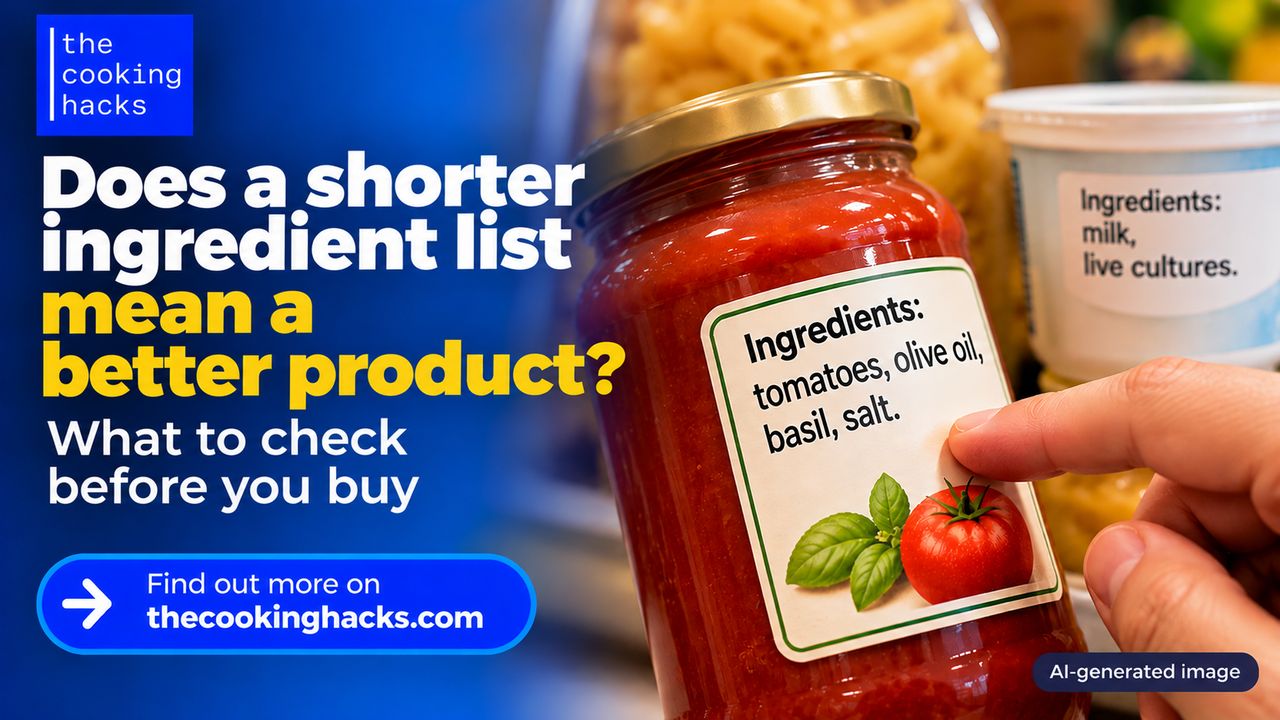
A shorter ingredient list does not automatically mean a food is healthier. Products made with just a few ingredients can still contain substantial amounts of sugar, salt or saturated fat. A simple recipe may be easier to understand, but choosing between packaged foods also requires checking their nutritional information.
Why are shoppers looking for simpler ingredients?
Interest in foods made with familiar ingredients is influencing how supermarkets present their products.
In October 2026, UK online supermarket Ocado Retail introduced a dedicated Simple Ingredients section featuring products selected according to specific ingredient criteria.
According to Ocado’s announcement, 74% of UK consumers surveyed said they preferred products containing ingredients they recognised.
The figure comes from research presented by the retailer and should not be treated as a measure of consumer preferences in every country.
Importantly, Ocado also acknowledges that its selection criteria do not guarantee a healthier diet.
The growing popularity of simple ingredient lists therefore raises a practical question: what can the label actually tell us about a food?
What does an ingredient list tell you?
An ingredient list identifies the components used to make a packaged food.
In the UK, US and European markets, ingredients are generally listed in descending order by weight, although the exact labelling requirements differ between countries.
This means the first ingredient usually contributes the greatest weight to the recipe at the relevant stage of production.
However, the number of ingredients does not tell you how much sugar, sodium or saturated fat a product contains.
For example, plain yogurt may have a very short ingredient list, while flavoured yogurt can contain additional fruit preparations, sweeteners or other components.
Counting ingredients alone cannot establish which product is nutritionally preferable.
Can food with only three ingredients still contain a lot of sugar?
Yes. Consider a biscuit or cookie made with flour, butter and sugar.
Its ingredient list may be short, but that tells you very little about the proportions used or the nutritional values of a serving.
A sauce made with only a few ingredients can also contain a substantial amount of salt.
The same applies to products marketed as natural or made with familiar ingredients.
A simple ingredient list is not the same thing as a balanced nutritional profile.
To understand the difference between two foods, shoppers need to look beyond the recipe description.
How should you compare nutrition labels?
Nutrition labels provide information that ingredient lists cannot.
In the UK, nutrition information is commonly presented per 100 g or 100 ml, making it easier to compare similar products.
In the US, the Nutrition Facts label places particular emphasis on values per serving, including calories and the amounts of key nutrients.
When comparing similar foods, useful information includes:
- Calories or energy
- Saturated fat
- Total and added sugars, where declared
- Sodium or salt
- Protein
- Dietary fibre, where available
The UK Food Standards Agency’s guidance on food labelling explains how ingredient lists and nutrition information serve different purposes.
Serving sizes also matter. A product may appear relatively low in sugar or sodium per serving simply because the stated serving is small.
Comparing equivalent quantities gives a clearer picture.
Are food additives always a problem?
No. Food additives perform different functions, including preservation, stabilisation, colouring and maintaining texture.
The presence of an authorised additive does not automatically make a food unsafe or nutritionally inferior.
Likewise, a product without artificial colours or preservatives can still be high in sugar, saturated fat or sodium.
It is important to distinguish between food safety, ingredient processing and nutritional quality.
These are related considerations, but they are not interchangeable.
An ingredient’s unfamiliar name is not enough to determine whether it is harmful, just as a familiar name does not guarantee a nutritional benefit.
How can you choose between two packaged foods?
Start by comparing products that serve a similar purpose.
For two breakfast cereals, check the ingredients alongside the amounts of sugar and fibre.
For two breads, consider the type of flour, fibre content and sodium or salt.
For two yogurts, examine the composition and nutritional information, taking account of differences between plain and flavoured varieties.
In the UK, comparing nutrition information per 100 g can make differences easier to identify. In the US, compare Nutrition Facts information using equivalent serving quantities rather than relying on different manufacturers’ serving sizes.
Price, personal preferences, allergies and the role of the food in your overall diet are also relevant.
A shorter ingredient list can make a product easier to understand, but it is not a reliable shortcut to healthier eating. The most useful choice comes from considering ingredients and nutritional values together.
Does a shorter ingredient list mean healthier food?
No. A short ingredient list can make a product easier to understand, but it does not guarantee lower amounts of sugar, salt, sodium or saturated fat.
Are ingredients listed in order of quantity?
Generally, yes. In the UK, US and European markets, ingredients are usually listed in descending order by weight, although the exact labelling rules differ.
How do you compare UK and US nutrition labels?
In the UK, compare nutrition values per 100 g or 100 ml. In the US, use the Nutrition Facts label and compare equivalent serving quantities, checking nutrients such as sugars, saturated fat and sodium.
Are foods without additives always healthier?
No. A food without artificial colours or preservatives can still contain substantial amounts of sugar, sodium or saturated fat. The absence of additives does not guarantee a balanced nutritional profile.
If you don't want to miss the important news, subscribe to The Cooking Hacks Telegram channels:
- Food Recall UK, receive news about food recalls to have a safe pantry
- Offers this week UK, to find out what are the latest offers from supermarkets