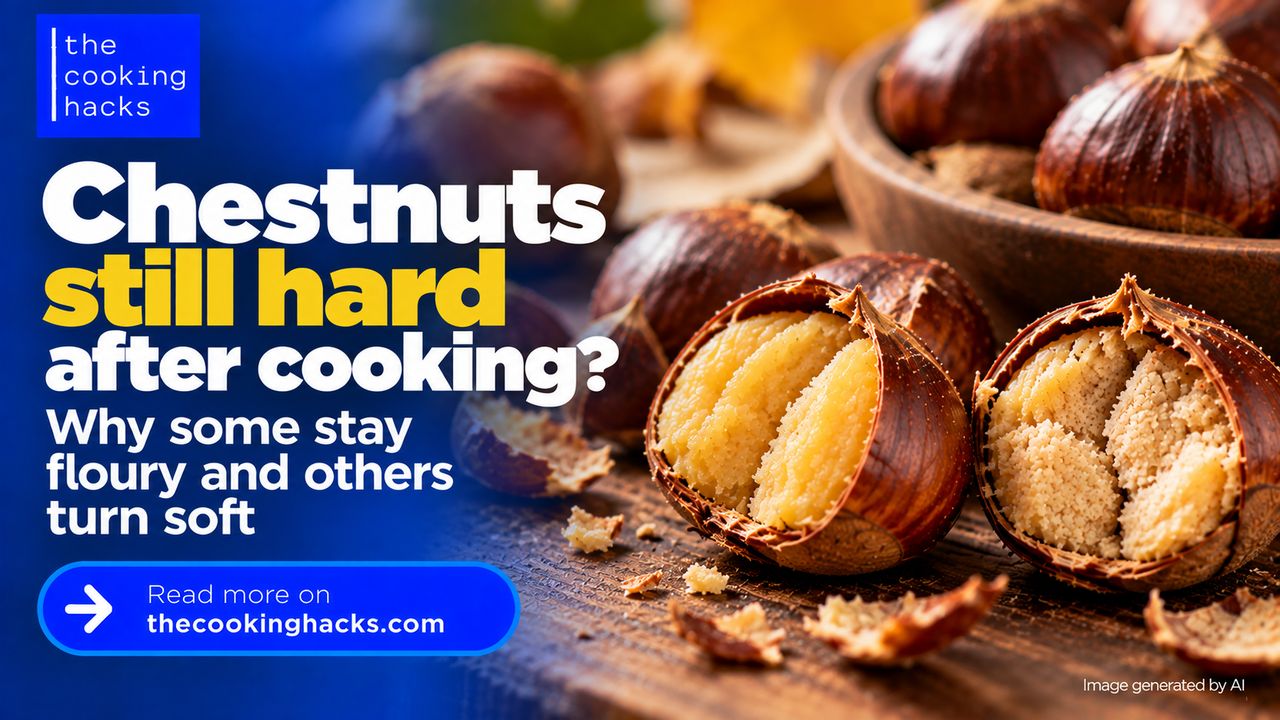
Cook a batch of chestnuts and the results can be surprisingly uneven. Some turn soft and creamy, others are drier and floury, and a few remain noticeably firm. Undercooking is one possible explanation, particularly if the centre is still raw, but cooking time alone does not determine chestnut texture. Variety, moisture, cell structure and the characteristics of the starch all play a part.
Chestnuts are quite different from walnuts, hazelnuts and almonds. They contain a large amount of starch and water and relatively little fat. That makes the way starch responds to water and heat particularly important when we want to understand why cooked chestnuts can have different textures.
What happens to starch when chestnuts cook?
A 2026 scientific review published in Horticulturae identifies starch composition and fine structure as major intrinsic factors affecting cooked chestnut texture. It also stresses that texture is a complex trait: moisture content and distribution, cell-wall structure and processing method contribute to the result as well.
The basic process is easier to understand than its scientific name suggests. When starch is heated with enough water, its granules take up water, swell and begin to lose their original ordered structure. This is called starch gelatinisation, and it is one of the changes that helps turn the texture of a raw chestnut into that of a cooked one.
A study of seven European sweet chestnut cultivars examined raw, boiled and roasted chestnuts. The researchers found major structural changes in the starch granules after cooking, as well as differences among the cultivars studied.
Why are some chestnuts floury while others are soft?
Starch is mainly made up of amylose and amylopectin, and their proportions and molecular structures influence how it behaves during heating. Research on chestnut starch has found associations between amylose content and several properties of the starch gel after cooking.
This should not be reduced to a rule that more or less amylose automatically makes a whole chestnut hard. Moisture, cell walls, variety, storage and cooking conditions interact with starch properties to determine the texture we actually experience when eating it.
The practical message is much simpler: two chestnuts cooked for exactly the same amount of time do not necessarily end up with the same texture. If one is still raw in the middle, it needs more cooking. If it is cooked through but simply firmer or more floury, the chestnut itself may be part of the explanation.
Boiled, steamed or roasted: cooking method matters
The amount of water available during cooking can make a major difference. A study comparing fresh, boiled and roasted chestnuts found changes in starch properties and kernel texture after thermal processing, with differences between boiling and roasting.
A more recent 2025 study comparing five cooking methods makes the practical difference particularly clear. Boiled chestnuts had the lowest measured hardness in that experiment, followed by steamed chestnuts, while the dry-heat methods produced firmer results. The researchers linked the softer texture of moist-heat cooking to water uptake and starch gelatinisation, while dry heat reduced moisture.
That does not make boiling automatically better than roasting. If you want a very soft chestnut for a purée, soup or dessert, moist heat may help achieve that texture. If you want roasted chestnuts, the drier texture and flavours created during roasting are part of the result you are looking for.
Air frying is another dry-heat method worth distinguishing from boiling and steaming. A 2025 comparison of thermal processing methods that included air frying found that the cooking technique affected chestnut structure, texture and sensory characteristics, reinforcing the point that changing the appliance can change more than just the cooking time.
Should you keep cooking chestnuts if they are still hard?
If the centre is still raw, yes. If the chestnut is cooked but simply firmer, not necessarily. This distinction is more useful than assuming that every firm chestnut just needs another ten minutes.
The starting condition of the chestnut matters too. Guidance from the UC Davis Postharvest Research and Extension Center notes the importance of preventing water loss during storage and identifies moisture as an important quality characteristic. A chestnut that has lost more moisture before it reaches the kitchen may therefore behave differently from a plumper one.
At home, choosing chestnuts of reasonably similar sizes can help them cook more evenly. Towards the end of cooking, test more than one rather than relying entirely on the number of minutes in a recipe.
So why do some chestnuts stay hard after cooking? Sometimes they are simply undercooked, but that is not the only possible reason. Starch structure, moisture, the characteristics of the chestnut and the cooking method work together, which is why one chestnut can become soft and creamy while another from the same batch remains firmer and more floury.
Why are my chestnuts still hard after cooking?
They may need more cooking if the centre is still raw. However, starch characteristics, moisture, variety and cooking method can also influence firmness.
Why are some cooked chestnuts floury?
Flouriness is influenced by several factors, including starch structure, moisture, cell structure and the way the chestnut is cooked.
Will cooking chestnuts longer always make them soft?
No. More time helps if they are undercooked, but it does not necessarily eliminate natural differences in texture between individual chestnuts.
Are boiled chestnuts softer than roasted chestnuts?
In comparative studies, moist-heat methods such as boiling and steaming produced softer chestnuts than several dry-heat methods. Water uptake and starch gelatinisation help explain the difference.
If you don't want to miss the important news, subscribe to The Cooking Hacks Telegram channels:
- Food Recall UK, receive news about food recalls to have a safe pantry
- Offers this week UK, to find out what are the latest offers from supermarkets